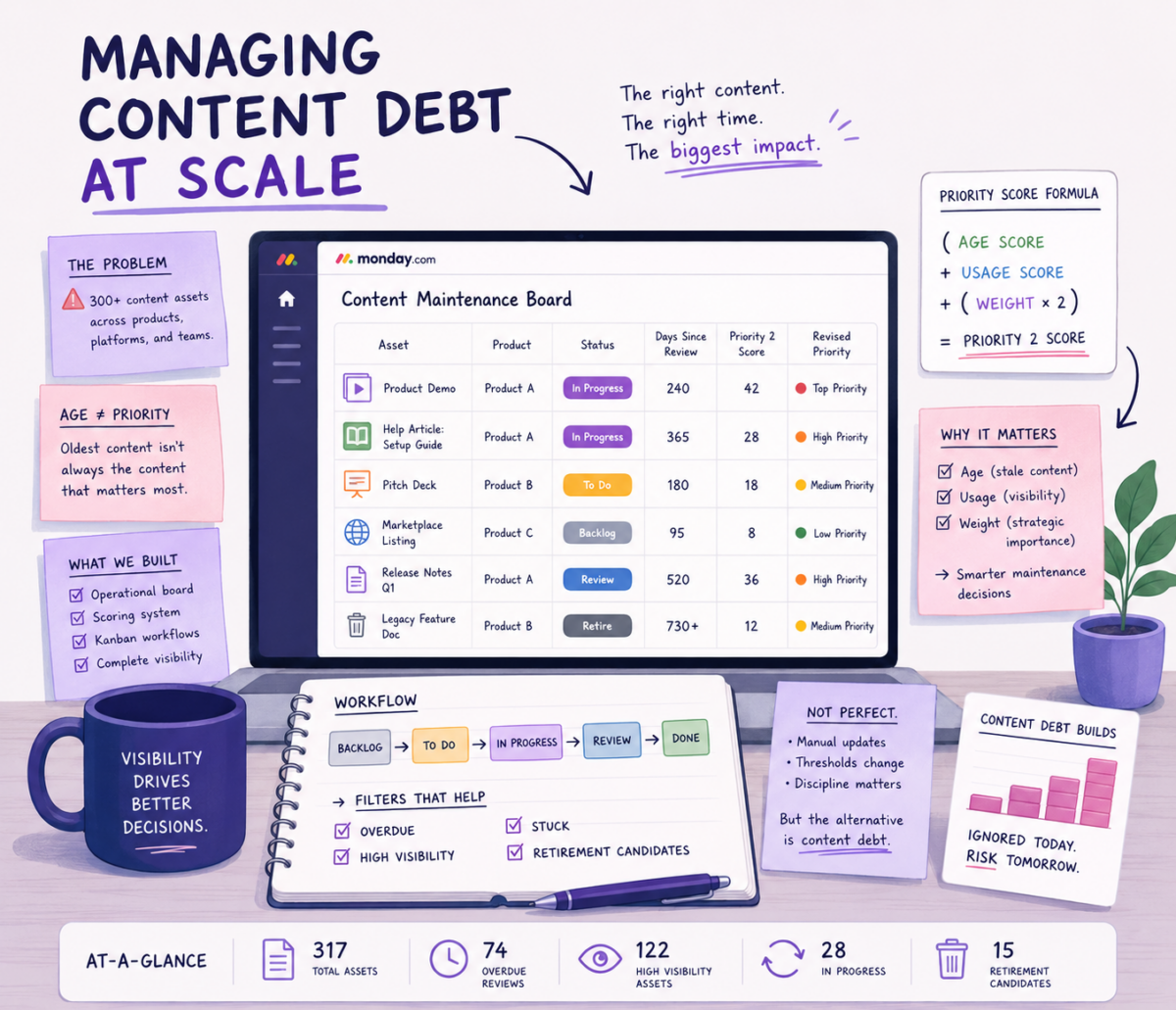

Managing Content Debt at Scale
At a certain point, documentation can exist and still not be trusted.
That happened gradually where I work. Nobody announced it as a documentation problem. The content footprint kept growing, and over time it became harder to know which assets were still safe to use.
Our team had accumulated hundreds of assets across multiple products and platforms:
Product demos.
Marketplace listings.
Training materials.
Internal documentation.
Support content.
Sales collateral.
Each asset made sense on its own. Together, they formed an ecosystem that was getting harder to maintain.
Some content changed constantly. Other content sat untouched for months until someone found it during a support escalation or customer conversation and realized it no longer matched the current product experience.
At first, the issues were easy to absorb.
A support representative linked to an outdated article.
A sales presentation included screenshots from a workflow that had changed several releases earlier.
Someone preparing for a customer demo realized during rehearsal that the marketplace listing still showed an older navigation structure.
None of these moments were catastrophic.
Teams worked around them with institutional knowledge, Teams messages, side conversations, and a few people who seemed to remember which version was still safe to reference.
That worked for a while.
Eventually, the hesitation became more visible.
People paused before sharing links externally.
Teams created duplicate assets because nobody was fully confident which version was authoritative.
Meetings started with several minutes of, “Are we looking at the current version?” before anyone could discuss the actual issue.
The documentation was no longer reducing verification work. It was creating more of it.
That was when the conversation changed for us. Creating documentation was not the hardest part anymore. Understanding which content carried the most maintenance risk was.
Managing Confidence Instead of Documents
The more I worked with the inventory, the less it felt like we were managing documents.
We were managing confidence in the information people used to do their jobs.
That sounds abstract until the content footprint gets large enough that different assets carry very different consequences.
Some content affects onboarding.
Some supports active customer implementations.
Some is rarely accessed until an unusual support case suddenly makes it important again.
An outdated support article can confuse customers.
An old sales deck can keep circulating internally for months.
A training resource that no longer matches the product can create rework across several teams before anyone notices.
The hard part was not spotting outdated content. We could usually tell when something was old once we looked at it.
The hard part was deciding what deserved attention first.
I originally assumed the oldest content would automatically be the highest priority.
That usually was not true.
Age mattered, but so did visibility, audience, business impact, release activity, ownership, and how the content was actually being used.
The Prioritization Problem
Our monday.com board started as a tracking system.
It had assignments, statuses, due dates, links, and review dates.
It helped us see what work existed.
It did not help much when we had to decide what work mattered most.
As the inventory grew, prioritization discussions started taking more time.
Everyone agreed that maintenance mattered. The disagreement was usually about what should be maintained first.
I found myself rebuilding the same context in planning conversations:
Who uses this?
How often?
What happens if it is wrong?
Does anyone own it?
How long has it been sitting untouched?
Eventually, I started capturing more of that information directly in the board.
Usage metrics.
Review history.
Ownership.
Audience.
Business priority.
Maintenance weighting.
The goal was not to make the system more complicated. It was to make prioritization decisions easier to explain.
Making Tradeoffs Visible
One of the first formulas I built increased urgency based on how long content had gone without review.
The formula changed several times, so the exact version was not the important part.
The useful part was that it made the tradeoffs visible.
A heavily used customer-facing asset should not carry the same maintenance priority as an internal reference document nobody has opened in two years.
But traffic was not enough by itself.
Some low-usage assets still mattered because they supported onboarding, implementations, compliance conversations, or support workflows that became painful when the content drifted out of date.
Without structure, the discussion usually ended in the same place:
“We should update the documentation.”
That was true, but it did not help us decide where to start.
Once weighting and context were visible, the conversations became more specific.
We could see high-visibility assets that were overdue for review.
We could see ownership gaps.
We could see content tied to active releases.
We could identify retirement candidates, stalled review cycles, and product areas with larger maintenance backlogs.
The system did not remove judgment.
It gave us better context for making judgment calls.
Content Debt Accumulates Quietly
During this process, stale content started to look a lot like technical debt.
The pattern felt familiar.
Small compromises that were reasonable in the moment became harder to untangle later:
Duplicate assets.
Outdated screenshots.
Legacy terminology.
Obsolete implementation guidance.
Sales collateral that no longer reflected current workflows.
Training materials built around assumptions that had changed.
A broken feature usually gets escalated.
Content issues are quieter.
People spend more time verifying information.
Teams create duplicate resources.
Questions move into Teams chats instead of the documentation.
Employees become less willing to trust published content without checking with someone first.
Nobody opens a ticket that says documentation credibility is declining.
But it shows up in how people use, avoid, and verify information.
Maintaining the Maintenance System
I underestimated how much maintenance the maintenance system would need.
Business priorities changed.
Products evolved.
Teams reorganized.
Ownership shifted.
Scoring models that made sense one year did not always reflect how the business worked the next year.
The system needed review just like the content it was built to manage.
I still keep separate trackers outside the primary workflow for things that do not fit neatly into the board:
Retired URLs.
Archived marketplace copy.
Reusable YouTube descriptions.
Deprecated terminology.
Migration notes.
Historical screenshots.
These are small pieces of context that continue to matter after the original asset is removed, replaced, or archived.
When that context is not maintained, the system becomes less trustworthy faster than I expected.
That may be the clearest lesson from the whole process.
Confidence is not established once.
It has to be maintained.
So do the systems built to protect it.